
Introduction
From ancient dice carved out of bone to modern digital betting platforms glowing on phone screens, games and gambling have followed humanity through every stage of civilization. Wherever people gathered — around fires, in marketplaces, royal courts, or online spaces — they competed, predicted outcomes, and risked something valuable for the thrill of uncertainty. The attraction has never been limited to money. At its core, it is the excitement of possibility, the tension between control and chance, and the emotional surge that comes from not knowing what will happen next.
Games and gambling may appear similar, but they operate on different foundations. Games reward skill, learning, and strategy, allowing players to improve over time. Gambling, however, relies largely on luck, offering instant outcomes that can change fortunes within seconds. Yet both captivate the human mind because they trigger anticipation, hope, and emotional engagement stronger than most everyday activities.
Understanding games and gambling is not only about entertainment or risk — it is about understanding human behavior itself. Why do people enjoy uncertainty? Why do losses sometimes encourage further play instead of stopping it? And why does the possibility of a rare win hold so much power over decision-making? Exploring these questions reveals how psychology, emotion, and perception interact whenever people play with chance.
The Psychology Behind Games and Gambling
At first glance, games and gambling appear to be simple entertainment activities. People sit, play, win, lose, and leave. But beneath this surface lies a deep psychological system carefully tied to human emotion and behavior. The reason these activities remain popular across cultures and generations is not only fun — it is mental stimulation driven by anticipation and reward.
The human brain is naturally attracted to uncertainty. When the outcome of an event is unknown, attention automatically increases. This is the same reaction that occurs while watching a suspenseful movie or waiting for exam results. Games and gambling use this mechanism repeatedly, turning every round into a moment of emotional tension.
Anticipation Creates Excitement
The most powerful moment in any game is not the result — it is the seconds before the result. During this period, the brain releases dopamine, the chemical associated with motivation and pleasure. Interestingly, research shows dopamine rises more before the reward than after receiving it. This means players are driven more by the possibility of winning than the win itself.
In games of skill, anticipation comes from strategy. A player calculates moves, predicts opponents, and feels satisfaction in decision-making. In gambling, anticipation comes from chance. The player waits for fate to decide. Both trigger excitement, but the source differs — effort versus luck.
The Role of Risk and Reward
Human beings are wired to evaluate risk constantly. From early survival situations like hunting and exploring to modern financial decisions, risk assessment shapes behavior. Gambling compresses risk into a fast and visible form. Within seconds, a person experiences gain or loss, making it emotionally intense compared to everyday decisions.
Small wins play a major psychological role. Even minor rewards reinforce the behavior and encourage continuation. The brain interprets these wins as proof that success is possible again. This is why occasional success keeps players engaged longer than consistent outcomes would.
Emotional Investment
Players often develop personal attachment to certain numbers, cards, or patterns. These attachments create a sense of relationship with the game. Although outcomes remain random, the mind prefers believing events are influenced by personal choice. This feeling of involvement strengthens engagement and keeps attention focused.
The Entertainment Factor
Despite the risks associated with gambling, many people participate purely for recreation. The lights, sounds, and structured format create a temporary escape from routine life. When approached with limits and awareness, it functions similarly to watching sports or playing video games — a controlled thrill rather than a necessity.
Understanding these psychological factors helps explain why games and gambling continue to attract people worldwide. They do not only offer rewards; they provide emotional stimulation, suspense, and a break from predictable reality.
The Difference Between Skill-Based Games and Chance-Based Gambling
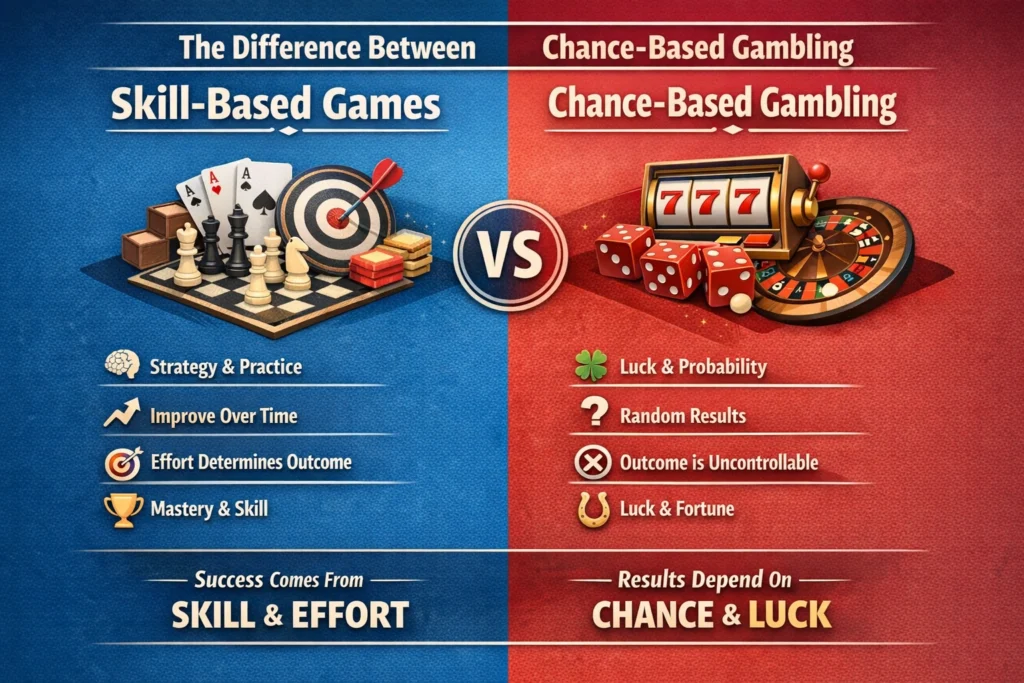
Although people often use the words games and gambling interchangeably, they operate on fundamentally different principles. The distinction is important because it determines how outcomes occur, how players improve, and how risk affects behavior. Understanding this boundary helps people recognize when they are engaging in entertainment and when they are relying purely on luck.
Skill-Based Games: Improvement Through Practice
Skill-based games depend on learning, strategy, and decision-making. The more a player practices, the better the performance becomes over time. Mistakes can be analyzed and corrected, which means results gradually reflect effort.
In these games, outcomes are influenced by:
- knowledge
- timing
- observation
- experience
- planning
A beginner may lose frequently, but improvement is predictable. Success feels earned because the player directly contributed to the result. Even losing can feel satisfying because it provides information for future attempts. The motivation comes from mastery rather than fortune.
Skill games stimulate concentration and long-term engagement. They challenge the mind, reward patience, and often encourage healthy competition. Because players see a clear connection between action and outcome, frustration usually decreases with learning.
Chance-Based Gambling: Outcomes Without Control
Chance-based gambling removes most influence from the player. The result is determined by probability rather than ability. Each round starts fresh, independent of previous results. No matter how long a person participates, the odds remain mathematically constant.
Here, the player cannot truly improve performance — only experience temporary streaks. Winning feels dramatic because it arrives unexpectedly, not because it was constructed through effort. Losses feel personal even though they are random.
This creates a powerful emotional loop:
- Random win produces excitement
- Excitement suggests repeat possibility
- Continued play maintains hope
Unlike skill games, learning does not significantly change future outcomes. However, the mind naturally searches for patterns, creating the illusion of progress.
Why the Difference Matters
The psychological impact of these two categories differs greatly. Skill games build confidence and persistence, while pure chance activities amplify emotional highs and lows. Problems arise when players treat gambling like a skill game, believing strategy alone can overcome probability.
A healthy perspective recognizes:
- Games reward effort over time
- Gambling rewards luck in moments
Both can be entertaining, but only one offers predictable improvement. Understanding this boundary helps maintain balance and prevents unrealistic expectations.
Ultimately, enjoyment comes from knowing what you are playing — a challenge to master, or a risk to experience.
Risk, Reward, and Player Behavior in Games and Gambling
In the world of games and gambling, risk is the central attraction. Without risk, there is no excitement, and without uncertainty, there is no emotional response. Every form of games and gambling operates on the same emotional cycle — anticipation, action, and outcome. What changes is how strongly the player reacts to each stage.
The Attraction of Risk in Games and Gambling
People participate in games and gambling because risk makes moments meaningful. When something valuable is at stake — money, points, status, or victory — attention increases immediately. The brain shifts from passive observation to active involvement. Even watching others engage in games and gambling can trigger the same tension.
Risk works differently in games and gambling:
- In games, risk tests ability
- In gambling, risk tests luck
Yet both create emotional engagement. A close match in competitive games produces excitement similar to a near win in gambling. The difference lies in control. In games, a player adjusts strategy. In gambling, a player waits for probability.
Reward Systems and Player Motivation
The reward structure in games and gambling directly shapes behavior. Large rewards are memorable, but small frequent rewards are more influential. A player who wins small amounts repeatedly feels encouraged to continue. This is called reinforcement — the key mechanism behind prolonged participation in games and gambling.
Casual players often believe big wins drive engagement, but psychology shows the opposite. Consistent minor rewards keep the brain expecting another positive outcome. This expectation strengthens motivation far more than a single large reward.
Emotional Highs and Lows
The emotional intensity of games and gambling comes from alternating results. Winning produces excitement, while losing produces tension. The combination keeps the mind focused. If outcomes were predictable, interest would quickly fade.
Many players continue games and gambling sessions longer than planned because emotions override time awareness. Minutes feel like seconds during suspenseful play. This effect is especially strong when results occur rapidly.
Chasing Outcomes
One of the most common behaviors in games and gambling is chasing. After a loss, a player believes the next round may reverse the result. After a win, a player believes luck continues. Both thoughts extend playtime.
Chasing occurs because the brain prefers closure. A loss feels incomplete, encouraging continuation until a positive outcome appears. This is why setting limits before starting games and gambling is more effective than deciding during play.
Perception of Probability
Humans naturally misunderstand probability in games and gambling. Random sequences appear meaningful even when they are not. For example, repeated losses can feel like a win is approaching, even though each round is independent.
The mind seeks patterns because patterns exist in most areas of life. However, in games and gambling governed by randomness, pattern recognition becomes illusion. Recognizing this helps players separate expectation from reality.
Maintaining Healthy Participation
Balanced involvement in games and gambling depends on awareness. Treating the activity as entertainment rather than income prevents emotional pressure. Players who approach games and gambling casually usually stop more easily because the purpose is enjoyment, not recovery.
Healthy habits include:
- setting time limits
- setting spending limits
- accepting outcomes calmly
- avoiding emotional decisions
Conclusion of the Section
The experience of games and gambling is built on risk and reward psychology. The activity itself is simple, but the emotional reaction is complex. Players return not only for winning but for suspense, anticipation, and engagement. Understanding these behavioral patterns allows people to enjoy games and gambling responsibly while avoiding unnecessary stress.
The Impact of Technology on Modern Games and Gambling
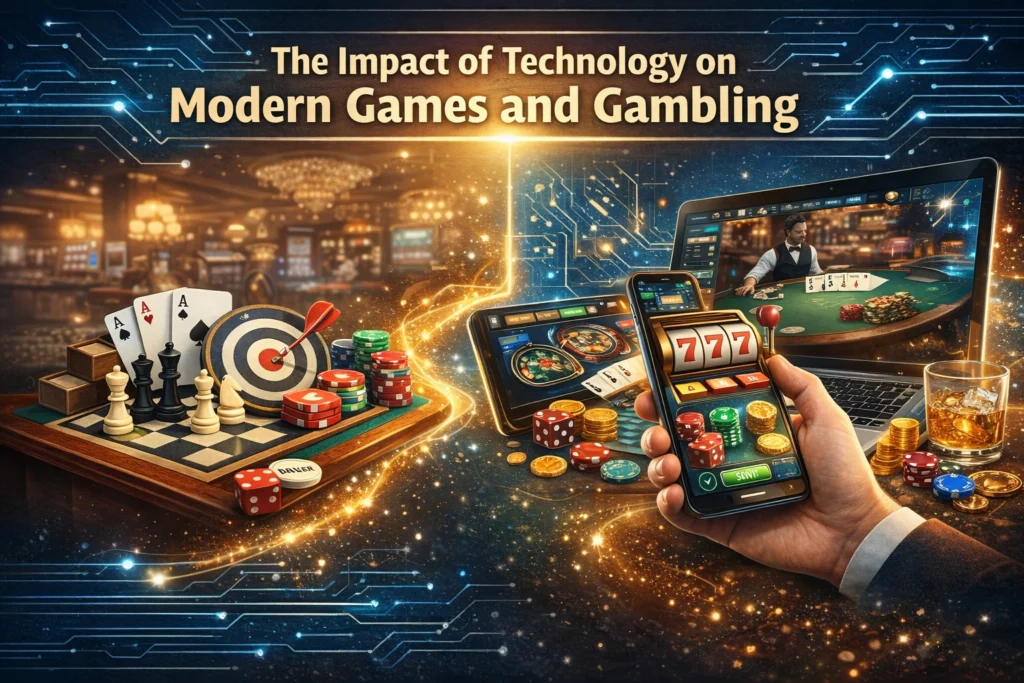
Technology has transformed games and gambling more in the last two decades than in the previous two centuries combined. What once required physical presence — a board, a table, or a venue — now exists instantly on screens. This shift did not only change access; it changed behavior, speed, and psychological response.
From Physical Play to Digital Play
Traditional games and gambling were limited by location and time. A person had to travel, gather with others, and play during specific hours. These natural barriers created pauses. Players stopped because the environment stopped.
Digital platforms removed these limits. Now games and gambling are available anytime and anywhere. A phone becomes a playing table, and the internet becomes the venue. Convenience increased participation dramatically because starting requires only seconds.
Faster Rounds, Stronger Engagement
In physical settings, each round of games and gambling takes time — shuffling cards, spinning wheels, arranging pieces. Online environments shorten this process. Outcomes appear almost instantly, which changes how the brain reacts.
Faster results create:
- more decisions per minute
- more emotional reactions
- less reflection between rounds
Because of this speed, players may continue longer without noticing. Continuous play keeps attention locked on the next outcome rather than the total time spent.
Personalization and Adaptive Systems
Modern games and gambling platforms often adjust presentation based on user behavior. Sounds, visuals, and notifications encourage engagement. When a person pauses, reminders appear. When activity increases, rewards may appear more frequently at first.
This does not change probability, but it changes perception. The player feels noticed and involved, which strengthens connection with the activity. The environment becomes interactive rather than passive.
Social Features and Competition
Technology also merged social interaction with games and gambling. Leaderboards, shared tables, and live chats recreate group experiences even when players are physically alone. Seeing others participate increases motivation because humans naturally follow collective behavior.
Competition adds another layer. Instead of playing only against chance, players compare results with others. This transforms solitary play into social engagement, increasing time spent in the activity.
Accessibility and Responsibility
Greater access means greater responsibility. When games and gambling become constantly available, self-control replaces environmental limits. Previously, closing hours ended play; now personal choice must end it.
Many platforms include reminders, session timers, and voluntary limits. These tools help players remain aware of time and spending, maintaining balance between entertainment and excess.
Changing Player Expectations
Technology reshaped what players expect from games and gambling:
- instant results instead of waiting
- continuous availability instead of schedules
- interactive experiences instead of static formats
While the core thrill of uncertainty remains the same, the pace and frequency intensified. The activity feels more immersive because there are fewer interruptions between decisions and outcomes.
Closing Thought
The digital era did not invent games and gambling — it amplified them. The emotional experience remains rooted in anticipation and chance, but technology removed barriers that once controlled duration. Understanding this change helps players stay aware of how environment influences behavior, allowing enjoyment without losing balance.
Social and Cultural Influence of Games and Gambling
Across history and geography, games and gambling have never existed in isolation. They grow within societies, shaped by traditions, celebrations, beliefs, and economic conditions. Different cultures treat games and gambling differently — some see them as harmless recreation, others as risky behavior, and many accept them only within specific occasions.
Festivals, Gatherings, and Tradition
In many communities, games and gambling appear during festivals and social gatherings. People play together not primarily to win money but to share excitement. The activity becomes a social connector. Families, friends, and neighbors gather around a table or screen, turning uncertainty into collective entertainment.
The key element here is shared experience. When individuals participate together, outcomes matter less than participation itself. A small win sparks laughter, and a small loss becomes part of the memory. In these settings, games and gambling strengthen relationships rather than isolate individuals.
Status and Competition
In competitive environments, games and gambling often become symbols of confidence and risk-taking personality. Some players participate to demonstrate boldness, patience, or mental strength. Winning publicly brings recognition, while even participation signals courage to face uncertainty.
This social perception explains why people sometimes play even when rewards are small. The value lies in reputation. The act of participating communicates confidence, which holds meaning in many social groups.
Economic Factors
Economic conditions strongly influence participation in games and gambling. During stable periods, people treat it as leisure. During stressful financial times, some view it as opportunity. The same activity shifts meaning depending on circumstances.
This change in perception affects behavior. Recreational participation involves limits, while opportunity-driven participation often increases emotional involvement. Understanding this difference is important because expectation changes the experience.
Media and Popular Culture
Movies, stories, and digital content frequently portray games and gambling as dramatic turning points — moments where fortunes change instantly. These narratives amplify fascination. They create memorable images of sudden success, reinforcing the idea that possibility always exists.
While entertainment focuses on rare events, everyday outcomes are usually ordinary. Yet repeated exposure shapes imagination, making the activity appear more transformative than it typically is.
Community Influence
People are influenced by those around them. When friends participate in games and gambling, individuals are more likely to join, not necessarily out of interest but belonging. Shared participation reduces hesitation and increases comfort.
Group environments also affect decision-making. Individuals may take larger risks collectively than they would alone because responsibility feels distributed. Awareness of this effect helps maintain personal boundaries regardless of social pressure.
Balance Between Recreation and Risk
Societies often attempt to balance enjoyment and protection. Regulations, guidelines, and public awareness aim to keep games and gambling within entertainment boundaries. The objective is not elimination but moderation — preserving enjoyment while reducing harm.
Cultural attitudes therefore shape behavior. Where awareness is high, participation tends to remain recreational. Where myths dominate, unrealistic expectations grow stronger.
Final Reflection of the Section
The role of games and gambling extends beyond individuals into communities and traditions. It reflects how people celebrate, compete, and cope with uncertainty together. Recognizing the social context clarifies why the activity persists across generations — not only because of winning or losing, but because it creates shared emotional experiences that few other activities replicate.
Responsible Participation and Self-Control in Games and Gambling
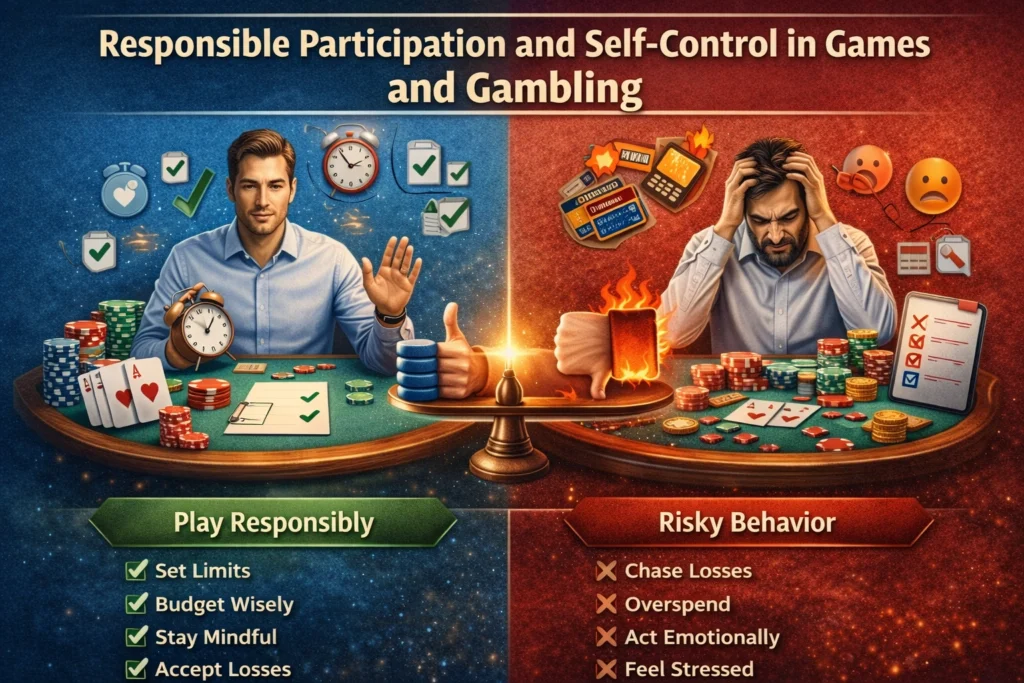
As games and gambling become easier to access and more engaging, responsibility becomes the most important skill a player can develop. The activity itself is not automatically harmful — the impact depends on awareness, limits, and intention. When people understand why they play and how long they play, games and gambling remain entertainment. When awareness disappears, the same activity can create stress.
Understanding Personal Motivation
Every person approaches games and gambling with a reason. Some play for fun, some for competition, and some for distraction. Problems begin when the purpose shifts from enjoyment to emotional relief. If a player starts depending on the activity to escape frustration or boredom, involvement gradually increases without conscious decision.
Asking simple questions helps maintain clarity:
- Am I playing for fun or for recovery?
- Would I still play if there were no money involved?
- Can I stop comfortably at any moment?
Honest answers create control. Without them, games and gambling may move from choice to habit.
Setting Limits Before Playing
The most effective protection in games and gambling is deciding limits before starting. Decisions made during excitement are emotional; decisions made beforehand are rational. Once play begins, anticipation influences judgment, making it harder to stop.
Healthy limits usually include:
- a fixed spending amount
- a fixed time duration
- a clear stopping point after wins or losses
Stopping after reaching the limit prevents the cycle of “just one more round,” which is common in extended sessions.
Managing Wins and Losses
Both winning and losing affect behavior in games and gambling. Losses encourage recovery attempts, while wins encourage continuation. In both cases, the player keeps playing for a different emotional reason than the original one.
A balanced approach treats outcomes the same way — as part of the experience. Viewing wins as temporary and losses as expected keeps emotions steady. The goal remains enjoyment rather than correction of results.
Avoiding Emotional Decisions
Emotions strongly influence decisions in games and gambling. Playing while stressed, angry, or overly excited often leads to longer sessions and higher risk-taking. Emotional states reduce patience and increase impulsive actions.
Taking breaks helps reset thinking. Even a short pause restores perspective and prevents automatic continuation. The mind becomes calmer, and choices become deliberate again.
Recognizing Warning Signs
Certain patterns suggest involvement is becoming unhealthy:
- difficulty stopping
- increasing spending to maintain excitement
- thinking about the activity constantly
- neglecting daily responsibilities
Noticing these early allows adjustment before habits strengthen. Awareness is not restriction; it is protection.
The Role of Balance
Like many forms of entertainment, games and gambling are best enjoyed as part of a balanced routine. When combined with other hobbies, social interaction, and rest, they remain occasional excitement rather than central focus. Variety prevents dependency because satisfaction comes from multiple sources.
Closing Thought
Responsible participation ensures that games and gambling stay what they are meant to be — moments of thrill within ordinary life, not replacements for it. Control does not remove enjoyment; it preserves it. A player who chooses when to stop experiences the activity fully, while a player who cannot stop experiences only tension. Understanding this difference turns risk into recreation and keeps the experience positive.
Frequently Asked Questions (FAQ) — Games and Gambling
1. What is the main difference between games and gambling?
The main difference in games and gambling is control. Games usually depend on skill, practice, and strategy, while gambling depends mostly on luck and probability. In games you can improve performance over time, but in gambling the odds remain constant no matter how much experience you have.
2. Why do people enjoy games and gambling so much?
People enjoy games and gambling because of excitement and anticipation. The brain releases pleasure chemicals while waiting for results, not just after winning. The uncertainty keeps attention focused and makes the activity emotionally engaging.
3. Can games and gambling become addictive?
Yes, games and gambling can become habit-forming if a person starts using them to escape stress, boredom, or financial problems. The risk increases when someone keeps playing to recover losses instead of playing for entertainment.
4. Are small wins more engaging than big wins?
Surprisingly, yes. In games and gambling, frequent small wins keep players involved longer than a single large win. Small rewards encourage continuation because they create the feeling that success is close again.
5. Does strategy help in gambling?
In most forms of games and gambling based purely on chance, strategy cannot change the mathematical odds. Strategies may help manage spending or time, but they cannot guarantee consistent wins.
6. Why do people chase losses?
Loss chasing happens in games and gambling because the mind wants closure. After losing, players feel the need to recover the loss quickly, believing the next round may reverse the outcome even though each round is independent.
7. Is online gambling different from traditional gambling?
Online games and gambling are faster and more accessible. Continuous availability and quick results can make players spend more time playing because there are fewer natural stopping points compared to physical environments.
8. How can someone play responsibly?
Responsible participation in games and gambling includes:
- setting time limits
- setting spending limits
- avoiding emotional decisions
- treating losses as entertainment cost
These habits help maintain balance and prevent stress.
9. Are games always safer than gambling?
Generally yes. Skill-based games are safer because improvement depends on learning rather than luck. However, excessive time spent on any activity, including games, can still create problems if it disrupts daily life.
10. Why will people always be attracted to gambling?
Humans naturally seek possibility and hope. Games and gambling offer instant uncertainty and immediate results, which makes them emotionally powerful. The attraction comes from the chance of change, even when the probability is small.
Conclusion
In the end, games and gambling represent two sides of the same human curiosity — the desire to challenge ability and the desire to test luck. Games reward patience, learning, and improvement, while gambling offers excitement through uncertainty and possibility. Both attract people because they create emotional intensity far stronger than routine daily activities.
The key difference lies in awareness. When people understand why they play and keep clear limits, games and gambling remain forms of entertainment. Without understanding, the same experience can shift from enjoyment to pressure. Balance, self-control, and realistic expectations allow players to experience the thrill without unnecessary risk.
For more information about responsible participation and gaming awareness you can visit mahadeviplid, and for broader online gaming resources you may also explore tiger365.
Ultimately, the purpose is not to avoid excitement but to enjoy it wisely. When approached with clarity and moderation, games and gambling stay what they are meant to be — moments of thrill, not matters of necessity.